DevSecOps
Infrastructure, tooling, and the security work that only gets noticed when it's missing.
What actually makes someone an IT professional, a network engineer, or an infrastructure engineer has shifted enormously since the CCNP era of the mid-1980s — and it's still shifting.
Infrastructure
Cloud vs. on-prem: what each actually offers
Both get pitched as the cheaper, safer option, and both have real hidden costs that only show up once you're committed. The two aren't interchangeable answers to the same question, they trade different things for different costs.
Cloud
On-demand compute and storage that scales up or down without buying hardware, managed services (databases, load balancers, ML platforms) that offload day-to-day operations, and billing that tracks as recurring operating expense instead of a large upfront purchase. The hidden cost shows up later: egress fees on data leaving the platform, and vendor lock-in once workloads come to depend on a provider's proprietary managed services.
On-prem
Full physical control over hardware and data location, which matters when compliance or data-residency rules require it, no egress fees moving data between your own systems, and predictable performance with no multi-tenant noisy neighbors. The hidden cost is upfront and recurring at once: a capital purchase for hardware, a refresh cycle every few years to replace it, and the staffing required to run and secure it around the clock.
| Dimension | Cloud | On-prem |
|---|---|---|
| Cost model | Operating expense, pay-as-you-go | Capital expense upfront, amortized over hardware's lifespan |
| Scaling | Elastic, scales in minutes | Fixed capacity, scaling requires new procurement |
| Ops burden | Shared with the provider via managed services | Fully owned by internal staff |
| Data control | Subject to the provider's regions and compliance offerings | Full control over physical location and access |
| Biggest hidden cost | Egress fees and vendor lock-in | Hardware refresh cycles and staffing |
| Best fit | Variable or unpredictable workloads, fast-moving teams | Steady, predictable workloads with strict compliance needs |
| Why it matters for AI | Supports the high-bandwidth, bursty traffic that training and inference workloads actually generate | Guarantees consistent results, since the exact GPU hardware in use directly impacts inference quality |
Neither answer is free; the honest question is which hidden costs you'd rather manage.
Definitions
What is DevSecOps — vs. DevOps?
DevOps means something different in the textbook than it does on most org charts. The gap between the two is worth understanding before comparing it to DevSecOps.
In theory
DevOps, on paper, is a set of practices that merges software development and IT operations into one continuous loop instead of two handoffs — CI/CD pipelines, infrastructure as code, automated testing, and monitoring feedback, aimed at shipping changes faster and more reliably by dissolving the wall between the people writing code and the people running it. Nobody hands a build to "ops" and waits; the same team that writes the code owns it in production.
In practice
Most orgs don't dissolve that wall, they hire for it: a "DevOps engineer" or "SRE" role sits next to frontend and backend engineers as its own specialization, and a dedicated DevOps or platform team owns deployment pipelines and tooling for everyone else. That's not a failure to implement DevOps correctly so much as it is the shape most companies actually settle into once they're past a certain size — the question isn't whether a dedicated team exists, it's what role that team plays for everyone else.
Team structure options
Three structures, three different places for the wall to reappear — inside each product team, between product teams and a platform team, or nowhere at all if every engineer is actually expected to carry an ops pager.
Pros and cons
| Structure | Pros | Cons |
|---|---|---|
| Embedded DevOps engineer per team | Fast, no cross-team ticket queue, context stays close to the code that's actually shipping | Practice quality varies team to team, tooling gets duplicated, hard to enforce one security or compliance baseline org-wide |
| Centralized platform/DevOps team | One paved road, a consistent tooling and security baseline, economies of scale on genuinely hard infrastructure problems | Can become a bottleneck and the default blame target when a deploy fails; product teams lose visibility into their own pipeline and queue behind the platform team's priorities |
| "You build it, you run it" | Maximum ownership, the fastest possible feedback loop, no handoff at all | Only works if every engineer is genuinely competent at operations; consistent practice is hard to sustain once headcount grows past a certain size |
Which outcome an org actually gets has less to do with which structure it picks than with whether the DevOps or platform function is treated as a shared resource other teams have real access to, or as a gate other teams have to go through.
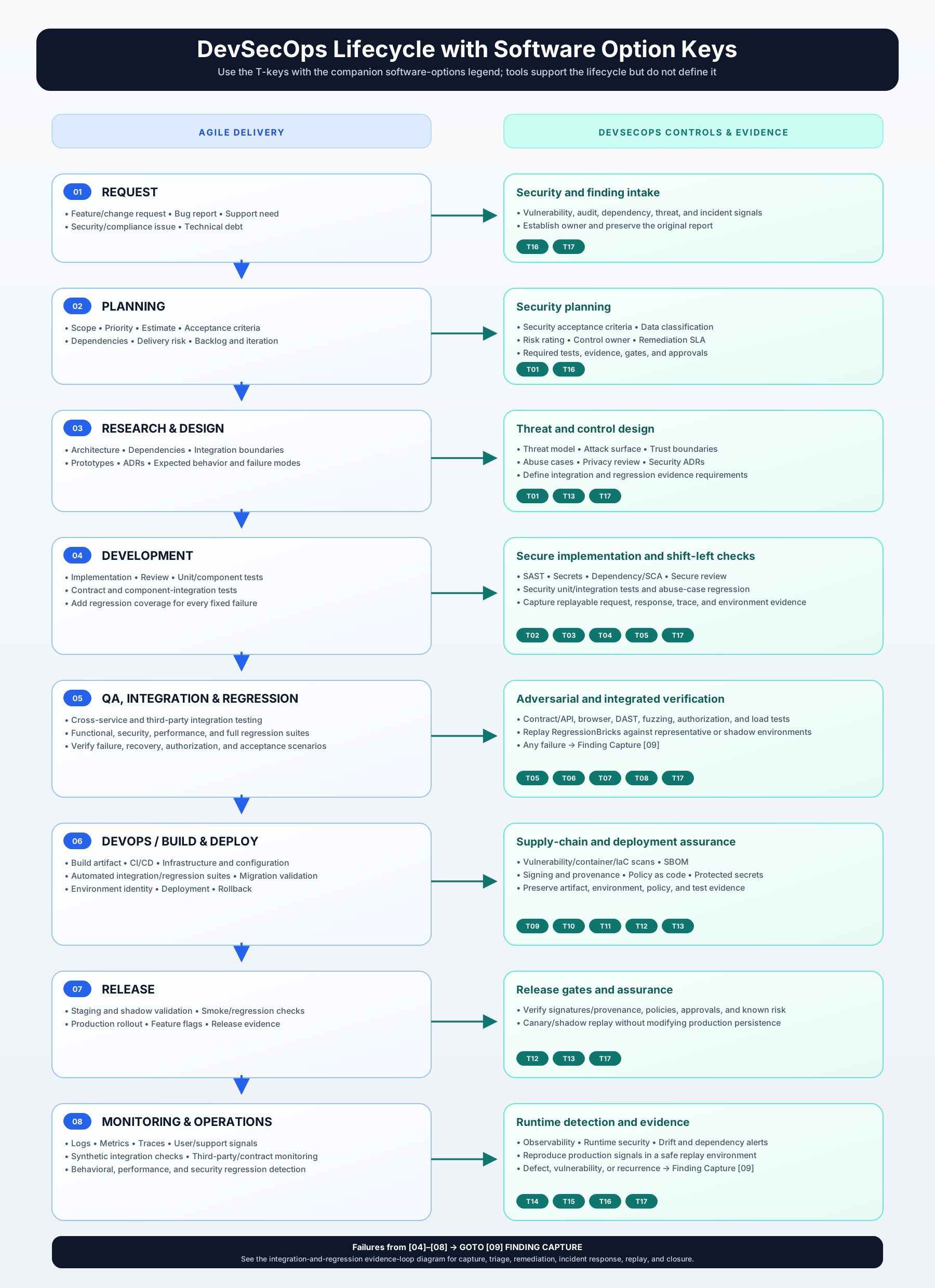
DevSecOps is DevOps with security embedded directly in that same loop, not bolted on at the end. Vulnerability scanning, dependency and software-composition checks, secrets scanning, policy-as-code, and threat modeling run at every phase of the pipeline — design, code, build, test, release, and operate — instead of arriving as a single security review gate right before release.
| Dimension | DevOps | DevSecOps |
|---|---|---|
| Primary goal | Speed and reliability of delivery | Speed and reliability of delivery without trading away security posture |
| When security is addressed | Usually after development, as a separate review or gate before release | Continuously, at every phase — design, code, build, test, release, operate |
| Core practices | CI/CD, infrastructure as code, automated testing, monitoring | All of DevOps' practices, plus SAST/DAST, dependency (SCA) scanning, secrets scanning, and policy-as-code |
| Primary metrics | Deployment frequency, lead time for changes, mean time to recovery | Same delivery metrics, plus mean time to remediate a finding and vulnerabilities that escape to production |
| Ownership | Shared between development and operations | Shared between development, operations, and security — security is everyone's job, not one team's gate |
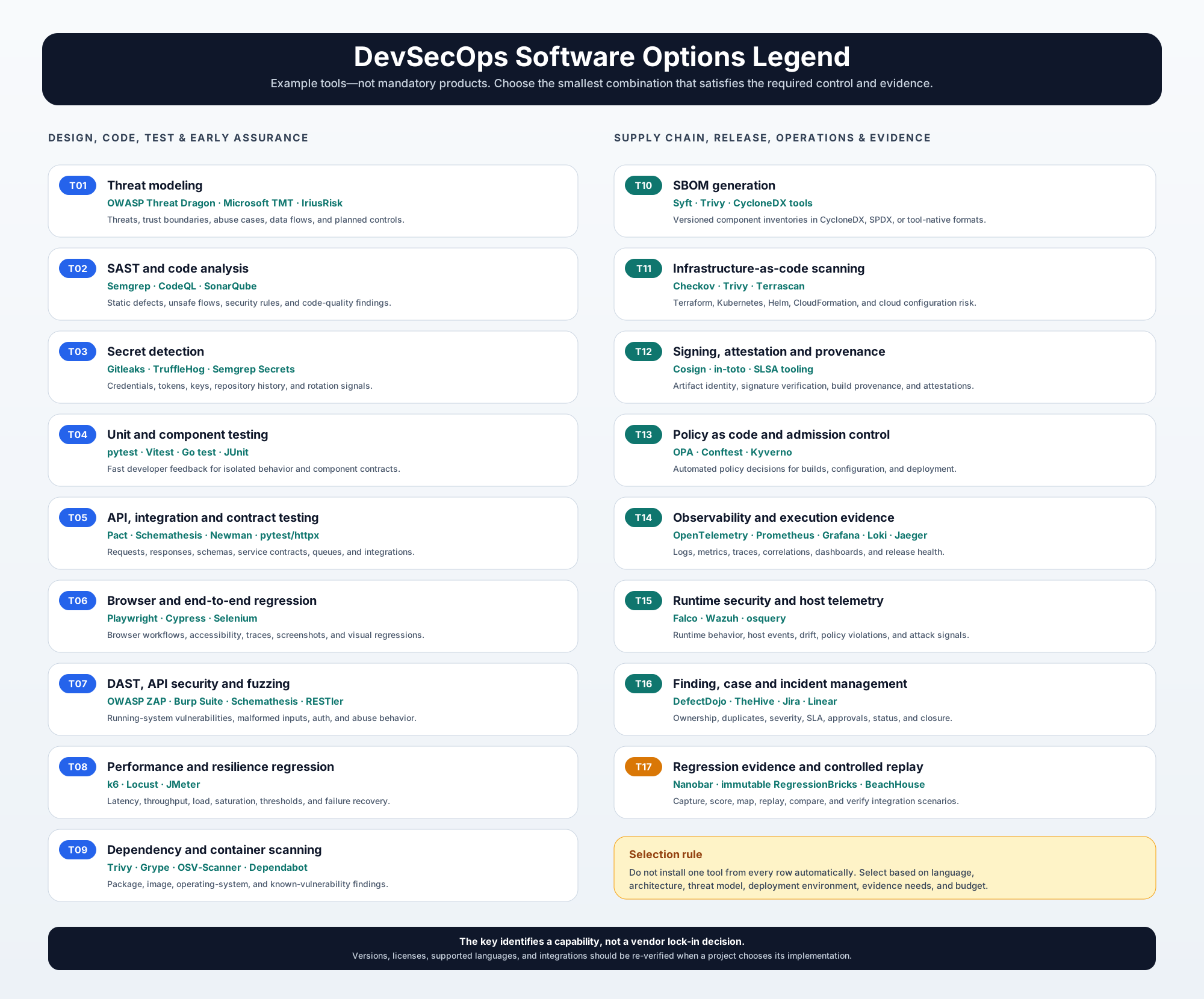
| Example tooling | GitHub Actions/Jenkins, Terraform, Datadog | The same stack, plus Snyk/SonarQube, policy engines like OPA, and secrets managers like HashiCorp Vault |
DevOps without security review built into the process.
This is a simpler loop on paper but the security work still must be done.
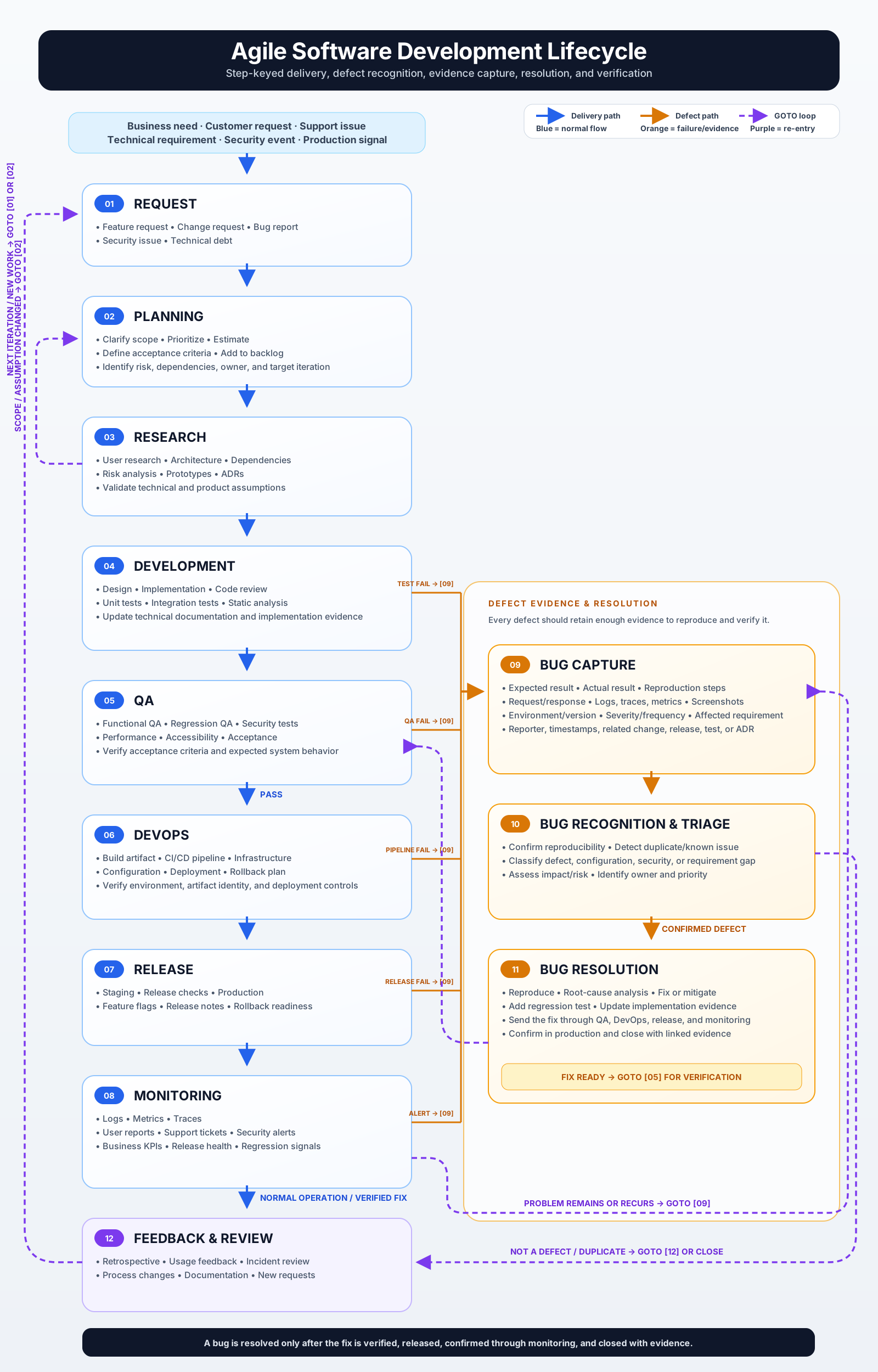
Related reading: Accelerate, Site Reliability Engineering, Designing Data-Intensive Applications, and the DORA research program.
AI Infrastructure
Why is DevSecOps critical for AI infrastructure today?
Start with the file format problem, because it's the most
concrete one: for years, the default way to save a PyTorch model
was Python's pickle format, which can execute
arbitrary code the instant it's deserialized. Hugging Face
introduced
safetensors
specifically to close that hole — it stores only raw
tensor bytes and a JSON header, with no code path that can
execute on load. That fixes one class of problem and leaves the
rest of the stack exactly as exposed as before: a safetensors
file can't run code when it loads, but nothing stops the weights
inside it from encoding a backdoor that only activates on a
specific trigger input, and plenty of ML pipelines still load
older pickle-based checkpoints (.pt, .bin, .ckpt) out of habit.
AI infrastructure didn't replace the old attack surface, it
stacked new ones on top of it — GPU drivers running as
privileged kernel modules, container setups that were never
designed for the access GPUs need, and model artifacts big
enough and valuable enough to be worth stealing outright. The
rest of this section walks through where that actually shows up.
Prompt injection — the case for curated knowledge
storage
Prompt injection comes in two shapes. The direct kind is a user simply talking a model into ignoring its own rules — in November 2023, a former X employee told a Chevrolet dealership's chatbot to agree with anything the customer said and to close every reply with a line declaring the offer legally binding, then asked for a $76,000 Chevy Tahoe for $1. The bot complied exactly as instructed, and the exchange went viral within days.
The indirect kind is harder to see coming, because the attacker never talks to the model at all. A 2023 paper by Greshake et al., “More Than You've Asked For”, showed that hidden instructions planted inside a webpage, document, or email — invisible to a human reader, sitting in an HTML comment or white-on-white text — get treated by an LLM-powered agent exactly like the user's own instructions once that content lands in the context window. In their demonstration, a browsing agent that was only asked to summarize a page ended up exfiltrating the user's data to an attacker-controlled endpoint, without the user ever writing a malicious prompt themselves.
Both cases point at the same underlying limit: a language model has no hard boundary between "instructions" and "data." Everything in the context window is just tokens, so any external content an agent is asked to read — a support ticket, a PDF, a GitHub issue, a search result — is an opportunity for someone else's instructions to ride in disguised as content. No amount of system-prompt wording fully closes that gap, because the model is being asked to both follow instructions and faithfully process arbitrary text in the same pass.
That's the case for curated knowledge storage: instead of letting a retrieval-augmented system pull freely from the open web or unreviewed user submissions at query time, maintain a vetted, access-controlled corpus with an ingestion pipeline that reviews and sanitizes content before it ever becomes retrievable, and tracks provenance per chunk so a bad entry can be traced and pulled. This doesn't make prompt injection impossible — a compromised internal document is still a document — but it collapses the attack surface from "anything on the internet the agent might fetch" down to "content that already passed your own review," which is a boundary an engineering team can actually defend.
Model files, safetensors, and what "safe" doesn't cover
Pickle-based model files are dangerous because deserializing
one runs Python code as a side effect — a malicious
.pt file downloaded from a public model hub can
execute on your machine the moment
torch.load() touches it, no separate exploit
required. Safetensors removes that specific mechanism: its
format has no executable payload path, so loading one cannot
run code.
What it doesn't remove is trust in the weights themselves. Trail of Bits' 2024 Sleepy Pickle research showed how a pickle file's own deserialization step can be hijacked to patch a model's weights in memory right after it loads — inserting a backdoor, tampering with outputs, or exfiltrating input data — all without changing a single byte the model was actually trained on. A self-propagating variant, Sticky Pickle, copies the same payload forward into every model version downstream of it. Safetensors closes the exact code-path Sleepy Pickle relies on, which is real progress, but a model file — in any format — is still a black box of numbers. Nothing in the file format checks whether those numbers were trained to misbehave on a specific trigger phrase or image before you ever run inference on it.
Kernel-level attacks on GPU infrastructure
AI workloads run on GPUs, and GPUs run through drivers that operate as privileged kernel modules — a very different trust boundary than a CPU-only web service. In 2024, Wiz Research disclosed CVE-2024-0132, a critical (CVSS 9.0) time-of-check-to-time-of-use flaw in the NVIDIA Container Toolkit that let a malicious container image escape entirely and gain full read access to the host filesystem, then pivot to root through the container runtime socket. Wiz estimated over 35% of cloud environments were exposed. The fix that shipped in 2024 was later found incomplete, and a follow-up bypass surfaced in 2025 — underscoring that a kernel-facing driver stack is a moving target, not a one-time patch.
In a shared GPU cloud, that isn't an abstract risk: a tenant's container escaping through the GPU driver lands directly on a host that may also be running other customers' training jobs, credentials, and model weights.
The limits of Docker — containers aren't as isolated
as they feel
A container is not a VM. Docker containers share the host's kernel through namespaces and cgroups, which means isolation is only as strong as that shared kernel's attack surface — a single kernel exploit (Dirty Pipe, Dirty COW, and their successors) can walk straight through every container on the box. AI workloads make this worse in a specific way: GPU passthrough typically requires elevated device access and capabilities that ordinary web-app containers never need, which is exactly the access the NVIDIA Container Toolkit flaw above abused. The more privileged a container has to be to do its job, the less the word "container" is actually buying you in terms of isolation.
It compounds further at the image layer: a typical ML Docker image pulls in a CUDA base image, a Python environment, and dozens of pip and conda packages, each with their own transitive dependencies that nobody on the team has individually audited. "It's containerized" reads as a security boundary; in practice it's a large, fast-changing dependency tree running with more host access than most engineers realize.
Corporate espionage and model theft
AI infrastructure concentrates an unusual amount of value into a small number of files: a trained model's weights can represent years of compute spend and proprietary data, compressible to a size that fits on a USB drive. In January 2026, a federal jury convicted former Google engineer Linwei Ding on economic espionage and trade secret theft charges — the first AI-related espionage conviction in the U.S. — after he uploaded over 1,000 files describing Google's AI data-center hardware and software stack to a personal cloud account while secretly running an AI company in China. No exotic exploit was involved; an authorized employee with legitimate access simply copied what he already had access to.
That's the uncomfortable part of AI-infrastructure security: access control, audit logging, and data-loss prevention on internal systems matter as much as anything covered above, because the people most capable of walking out with a model or its training infrastructure are the ones already inside the perimeter.
Other attack surface worth knowing about
- Supply-chain packages. PyPI and the Hugging Face Hub have both hosted typosquatted or outright malicious packages disguised as popular ML libraries — the same lesson as the pipeline story above, running at open-source speed.
- Secrets sprawl in notebooks. Jupyter notebooks routinely get shared, committed, or copied with cloud credentials and API keys hardcoded in a cell — a habit web developers mostly trained out of themselves years ago, but common in ML workflows.
- Model stealing via API access. An attacker with nothing but query access to a hosted model can systematically extract enough input/output pairs to train a functional copy of it, turning an API rate limit into the only real defense.
- Training-data and RAG poisoning. Anything a model learns from or retrieves at inference time is an injection point — a poisoned document in a retrieval index can steer output just as effectively as a compromised dependency can steer code.
- Multi-tenant GPU memory residue. Shared GPU clusters need to fully wipe device memory between tenants; a GPU that hands off VRAM still holding a previous customer's activations or weights is a data leak with no network traffic to detect it.
Landscape
Current DevSecOps tools and companies
A partial map of who's building in this space today: Snowflake and Databricks for the data platform layer; Cisco's newer local AI infrastructure push; Snyk and SonarQube for security and code-quality scanning; Datadog for observability; and Arize AI in the ML-observability corner. None of these are interchangeable — each solves a different piece of "how do I know my system is actually healthy and safe," and part of the DevSecOps job is knowing which piece you're missing.
Security
The ocean of logic bombs, viruses, and malware
Malicious code can live anywhere, and history has no shortage of case studies worth studying. A captain never sets sail intending to sink the ship, but no one sails safely without the right tools, either. Static analysis can only get you so far — monitoring, sandbox testing, and environment isolation are what actually let you map unproven technology, software updates, and hardware before they touch anything that matters.
One of the oldest case studies on record is also one of the most disputed: per the memoirs of Thomas Reed, a former Air Force secretary on Reagan's National Security Council, industrial-control software bound for the Soviet Union was quietly compromised somewhere along its supply chain before it ever reached the Trans-Siberian gas pipeline's SCADA system — a logic bomb built into legitimate-looking Canadian software, not something stolen or tampered with after the fact. The software ran correctly for months before deliberately mis-setting pump speeds and valve pressures until the line ruptured in what Reed described as the largest non-nuclear explosion ever recorded, visible from orbit, in June 1982. The account has never been independently confirmed — other former intelligence officials attribute the actual blast to a Soviet engineer overpressuring the line after finding a leak, not sabotage. Confirmed or not, it's the same lesson every logic bomb teaches: compromising software before it reaches its target required a state intelligence apparatus and a physical diversion in 1982. It's far easier today, when a single compiled dependency can pull in dozens of transitive packages nobody on the team has actually read.
One open question worth sitting with: what exactly are safe tensors, and can they be spoofed? It's the kind of question that sounds narrow until you realize how much trust gets placed in a model file just because it loaded without an error.
Data Privacy
The truth behind data privacy across a network: SSL, TLS, and encryption vulnerabilities
In 2025, researchers from UC San Diego's Department of Computer Science and Engineering — with collaborators from the University of Maryland — pointed roughly $800 of commercial satellite equipment at the sky from UCSD's own engineering building and started listening. Over seven months they intercepted transmissions from 39 geosynchronous satellites, about 15% of the 590 GEO satellites currently in orbit. Their finding, detailed in “The Sky Is Full of Secrets”, was that nearly half of everything they captured had no encryption at all.
What came down that link was not abstract. It included voice calls, text messages, and backhaul traffic for T-Mobile and the Mexican carriers TelMex and WiBo; in-flight passenger internet activity carried over Intelsat and Panasonic entertainment systems; internal corporate email and sales data from Walmart, including its Mexico operations; bank network traffic; U.S. naval vessel communications; and location and personnel data for Mexican military aircraft, ships, and law enforcement. As the researchers put it, there is a clear mismatch between how satellite customers expect their data to be secured and how it is actually handled. T-Mobile, Walmart, and KPU Telecom switched on encryption only after being told.
None of this required breaking a cipher. It required assuming that a satellite downlink was too physically inaccessible to matter, an assumption that a $800 dish on a rooftop quietly disproved. That is the same failure mode that shows up at every layer of network security covered below: encryption gets treated as optional whenever the transport feels private, whether that transport is a satellite backhaul link, an old TLS configuration nobody re-audited, or a chip design nobody stress-tested for a side channel. The sections below cover the actual algorithms in use today, the SSL-to-TLS history, why hardware-level encryption is its own discipline, how HIPAA and SOC 2 actually differ, and what unenforced encryption ends up costing in practice.
Encryption options: use cases, security, cost, and
crackability
| Algorithm | Best use case | Security rating | Computational cost | Crackability |
|---|---|---|---|---|
| AES-256 (symmetric) | Data at rest, disk/database encryption, VPN tunnels | Very high | Low — hardware-accelerated on nearly every modern CPU (AES-NI) | No practical brute-force path (2256 keyspace); real breaks come from key theft, not the cipher |
| ChaCha20-Poly1305 (symmetric) | Mobile and TLS on devices without AES hardware support | Very high | Low — fast in pure software, no special hardware required | No known practical attack |
| RSA-2048 (asymmetric) | TLS key exchange and certificate signing (legacy-compatible) | High — NIST-approved through roughly 2030 | High — slow at scale relative to elliptic-curve alternatives | Not broken classically; theoretically breakable by a sufficiently large quantum computer (Shor's algorithm) |
| ECC — P-256 / Curve25519 (asymmetric) | Modern TLS key exchange, mobile and IoT | Very high | Low — matches RSA-level security at roughly a tenth of the key size | Not broken classically; carries the same long-term quantum exposure as RSA |
| 3DES (symmetric) | Legacy payment and banking systems only | Low — deprecated by NIST in 2023 | Medium-high — three sequential encryption passes | Practically broken via the Sweet32 birthday attack on its 64-bit block size |
| DES (symmetric) | None — retained only inside old hardware | Very low | Low | Brute-forced in hours on commodity hardware (56-bit key) |
| CRYSTALS-Kyber (post-quantum) | Forward-looking TLS key exchange, NIST-standardized in 2024 | High — emerging standard | Medium — larger keys and ciphertexts than ECC | No known classical or quantum break; the leading candidate for the eventual RSA/ECC replacement |
SSL — Secure Sockets Layer
SSL was Netscape's original protocol for encrypting traffic between a browser and a server, first shipped as SSL 2.0 in 1995 and replaced within a year by SSL 3.0 after 2.0 turned out to have serious design flaws. SSL 3.0 lasted much longer, but it too is broken: the 2014 POODLE attack showed how to force a connection to downgrade to SSL 3.0 and then exploit its padding scheme to decrypt data byte by byte. Every version of SSL is now formally prohibited under PCI DSS, and no modern browser will negotiate it.
The catch is naming, not technology: “SSL certificate” and “SSL/TLS” remain the common shorthand for what is actually TLS running underneath. That legacy phrasing still shows up in vendor contracts and compliance questionnaires today, which is worth knowing before assuming a document that mentions “SSL” is describing something insecure.
TLS — Transport Layer Security
TLS is SSL's successor, standardized by the IETF starting with TLS 1.0 in 1999. TLS 1.0 and 1.1 were formally deprecated in 2020–2021 after years of known weaknesses (BEAST among them), and PCI DSS has required TLS 1.2 or higher since 2018. TLS 1.2, from 2008, is still acceptable when configured with strong cipher suites and no legacy CBC-mode padding exposure — but it is easy to misconfigure into an insecure state, because it still permits those legacy options.
TLS 1.3 (2018) is the current standard and removes that footgun entirely: it drops every legacy cipher suite, mandates forward secrecy through ephemeral key exchange on every connection, and cuts the handshake down to one round trip (with an optional 0-RTT mode). The practical takeaway is that a valid certificate says nothing about whether the server behind it still allows an old TLS version, a weak cipher, or improper certificate validation — encryption in transit is a configuration discipline that has to be checked, not a box that gets checked once.
Hardware-based encryption
Every layer discussed above assumes the CPU, firmware, and silicon underneath it can be trusted to do what the algorithm says. Hardware-based encryption is what happens when that assumption itself gets tested — TPMs, hardware security modules, and secure enclaves that keep keys and crypto operations off the general-purpose CPU entirely, plus a separate discipline of verifying that a chip's own design has no exploitable flaw baked into it. That distinction matters because a defect at the microarchitecture or silicon level, like an undocumented debug path or a timing side channel, survives every operating system patch and every TLS upgrade running above it. Nothing in software can fix a mistake that shipped in the die.
Cycuity is one of the companies built specifically around that problem: static and dynamic security verification tooling (its Radix product line) that checks a chip's RTL design and firmware for known weakness classes and traces information flow through the hardware before it ever tapes out, rather than after it ships. The approach traces back to hardware-security research from UC San Diego's Kastner Research Group (Kastner Lab), the same lab known for pioneering gate-level information-flow tracking as a way to catch hardware vulnerabilities on paper instead of in production.
HIPAA vs. SOC 2 compliance
These two get confused constantly because both are used to justify the same encryption and access-control work, but they answer different questions for different audiences.
| Dimension | HIPAA | SOC 2 |
|---|---|---|
| What it is | U.S. federal law (the Security Rule) governing Protected Health Information | Voluntary AICPA attestation against the Trust Services Criteria |
| Enforcement | HHS Office for Civil Rights; per-violation fines and breach-notification duties | No regulator — enforced by customers requiring the report before signing a contract |
| Encryption requirement | Listed as “addressable” — implement it or formally document an equivalent alternative | Scored as evidence of a control operating effectively, not mandated by name |
| Primary audience | Regulators and patients whose PHI is at risk | Enterprise customers and procurement teams doing vendor risk review |
In practice: HIPAA asks whether PHI was adequately protected and whether that can be defended in a federal audit. SOC 2 asks whether an independent auditor observed a company's controls actually operating as described over a period of months. A company can hold a clean SOC 2 report and still not be HIPAA-eligible without a signed Business Associate Agreement and PHI-specific controls — they are not tiers of the same ladder, they are answers to two different questions.
Why does it matter?
The costs below are drawn from public reporting on fines, settlements, and remediation spend, then divided by ten to make the numbers comparable across very different incidents. Treat the per-year figures as an illustration of scale, not an audited actuarial number.
- The Trans-Siberian pipeline explosion (1982, disputed). Per the memoirs of Thomas Reed, a former Air Force secretary on Reagan's National Security Council, industrial-control software bound for the Soviet Union was quietly compromised somewhere along its supply chain before it ever reached the Trans-Siberian gas pipeline's SCADA system — a logic bomb built into legitimate-looking Canadian software, not something stolen or tampered with after the fact. The software ran correctly for months before deliberately mis-setting pump speeds and valve pressures until the line ruptured in what Reed described as the largest non-nuclear explosion ever recorded, visible from orbit, in June 1982. The account has never been independently confirmed — other former intelligence officials attribute the actual blast to a Soviet engineer overpressuring the line after finding a leak, not sabotage. If Reed's version is accurate, it is one of the earliest known software supply-chain attacks, and the lesson only gets sharper with time: compromising software before it reaches its target required a state intelligence apparatus and a physical diversion in 1982. It is far easier today, when a single compiled dependency can pull in dozens of transitive packages nobody on the team has actually read. The 2024 XZ Utils backdoor — years spent building trust as a maintainer before slipping remote-code-execution into a compression library used by OpenSSH across most Linux distributions — is the same playbook running at open-source speed. Think twice before reaching for that convenient open-source package; a logic bomb can sit compiled and dormant inside it, waiting for the moment it does the most damage.
- Unencrypted satellite backhaul (2025). The UC San Diego study above found live, unencrypted traffic from T-Mobile, Walmart, Intelsat/Panasonic in-flight systems, banks, and U.S. and Mexican military and police channels — passively interceptable by anyone with about $800 of gear, for as long as the misconfiguration existed. No theft was confirmed because this was a research disclosure, not an attack, but that is the point: passive satellite eavesdropping leaves no trace, so the honest cost isn't a settlement figure, it's years of unmeasured exposure across military, banking, and retail traffic. Unmeasured risk is the most expensive kind, precisely because no one can price it in advance.
- Heartbleed (2014). A bug in OpenSSL's TLS heartbeat extension let anyone pull up to 64KB of raw server memory per request — private keys, session cookies, credentials — from roughly 17% of the internet's TLS-secured servers. Banks, governments, and major platforms had to mass-reissue certificates and force password resets within days. One widely cited estimate put global remediation near $500 million, normalizing to about $50 million a year in ongoing OpenSSL-ecosystem auditing and cert-rotation discipline that traces directly back to one line of missing bounds checking.
- Equifax (2017). An unpatched Apache Struts vulnerability exposed Social Security numbers, birth dates, and addresses for 147 million people. Congressional hearings and executive departures followed, along with a reputational hit to a company whose entire business is trust in data handling. Combined settlement, legal, and remediation costs are commonly cited near $1.4 billion — roughly $140 million a year normalized — enough to fully fund a Fortune 500 security organization for a decade, spent instead on a breach that already happened.
- Capital One (2019). A misconfigured web application firewall allowed a server-side request forgery attack that reached AWS credentials and pulled data on 106 million customers out of S3 storage. An $80 million OCC fine plus roughly $190 million in customer settlements put the total near $270 million, or about $27 million a year normalized — for a single cloud configuration mistake.